
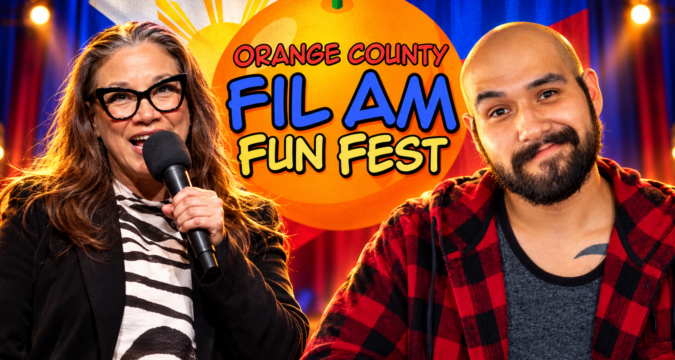
CHOPSO spoke with Erik Escobar, founder and producer of Fil Am Fun Fest, and Bay Area comedian Diane Belale. The festival runs October 22–24, 2026, at venues throughout Orange County. For more information, visit the festival’s website.
Quentin Lee: Hi, everybody. Joining me today is Erik Escobar, founder and producer of Fil Am Fun Fest, a stand-up comedy festival taking place October 22–24 in Orange County. We also have fellow comic Debra Belale, known as DB, with us. Erik, tell us a little about the festival and how it came together.
Erik Escobar: Absolutely. This is the first year of the Orange County Fil Am Fun Fest. We’re bringing comics from all over the country together to celebrate Filipino American comedy and share that culture, love, and energy through shows in Anaheim, Placentia, and San Clemente. We’re covering a pretty big region.
It started because I produce a few monthly and quarterly shows, and throughout the year, I love putting together themed lineups. Sometimes I’ll do an all-AAPI show. October is Filipino American History Month, so I love celebrating Filipino American comics then. This year, we thought it would be fun to bring all the shows we usually produce together into one weekend and invite comics from wherever they might be available to join us.
It’s been really exciting—and a lot of work. A little stressful, too. I had a full Afro when we started producing this festival. I still do, but I’ll show you later!
We’re excited to have so many amazing performers, sponsors, and supporters come on board and help realize this vision: supporting comedy, celebrating Filipino Americans, and having a great time here in OC.
Quentin Lee: Why Orange County? Is there a particularly large Filipino community there?
Erik Escobar: As a comedian and producer, I’ve been lucky enough to put on shows throughout Los Angeles, San Diego, and Orange County. I used to live in LA, and I’m excited to see Filipino American representation and talent thriving there.
A couple of years ago, my partner and I got married and moved to Orange County. There’s a lot of Fil-Am love here, but I think there’s always room for more celebration of our culture and comedy community. LA has a great scene. San Diego is incredible. OC is right in the middle, so let’s bridge that gap and bring more Filipino Americans out here to have a great time.
Quentin Lee: DB, would you introduce yourself and tell us how you got into comedy?
Debra Belale: Sure. I’m DB—Debra Belale—and I’m based in San Francisco. I came to comedy later in life. I started during the pandemic, when I was already married with kids.
A friend of mine had to pivot because all his performance dates were on hold and the clubs were closed. He started teaching an online joke-writing class, and I thought that sounded like fun, so I took it. Then I did some Zoom comedy shows, and I loved it.
My comic friends kept saying, “You’ve got to do this in person when things open up. Go to a bar, try an open mic, and see if you really like it.” That was six years ago, and I haven’t stopped. That’s my origin story.
Quentin Lee: Amazing.
Debra Belale: Still going!
Quentin Lee: Erik, what’s your origin story? You’re something of an OG. You’ve gone from stand-up comic to teacher and now festival founder. How did that happen?
Erik Escobar: I also started during the pandemic. I was 18 years old. No, no—I started 18 years ago!
I started in college. I never really wanted a day job; I was very afraid of that. So I prioritized stand-up and made it my thing. It’s been an amazing journey.
One of the coolest things about stand-up—and comedy in general—is the community. As humans, we love finding someone who says, “Oh, you get this niche, specific thing? I get it, too. Let’s nerd out about it, celebrate it, and love it.”
That’s a beautiful part of comedy, and it’s also a beautiful part of being AAPI and Filipino American. We have this community. We have each other. I love performing and producing comedy, so why not bring those worlds together through a community of Filipino Americans and great Orange County stand-up?
Over the years, I’ve done a lot of improv and sketch and eventually found my way in stand-up. This October is probably one of the best months of my career. Not only is Fil Am Fun Fest happening, but my special, as part of Comedy InvAsian, came out earlier this month. You can catch it on Asian American Movies and Prime.
It’s an exciting time in my life and career. I can’t think of a better way to wrap up Filipino American History Month than with this festival and all these amazing comics.
Quentin Lee: This next question is for both of you, starting with DB: How does being Filipino shape your identity and perspective as a comic?
Debra Belale: There are dynamics I get to talk about that people are curious about, but that are very common in the Filipino American experience—especially if you’re a woman.
A big part of my material is about being married to a white guy, how that dynamic plays out, and how we’re raising our kids together. It’s something I’m uncovering more and more through comedy.
I don’t see a ton of other Filipino moms and partners talking about the same things, so I feel like I’m in the right place to express that perspective.
Quentin Lee: What about you, Erik? You’re Filipino and Mexican, right?
Erik Escobar: Mexipino—not the brand. You’ve got to trademark it, or someone’s going to take it. They can have it. No, I want it! I’ll do that after this.
One of the first times comedy made me feel that warm, fuzzy sense of community was in sixth grade. A friend had Rex Navarrete’s comedy on his iPod.
You hear jokes and think, “Oh, that’s funny. I get that.” But when you hear something so specific that you think, “I didn’t know anyone else felt that way or saw it like that,” it means something more. It showed me that the more you share your experiences, your identity, and those little details of your world, the more meaningful the connection can be when someone recognizes themselves in it.
Hearing Rex talk about the first-generation Filipino American experience helped shape how I understood comedy. I realized you could connect with people through those small things in a way that was celebratory and fun.
I also love my Filipino mom. She’s the best. She’s amazing. A little critical! I don’t know if that’s just her or a broader thing, but she could always spot something and say, “What’s weird about that?” or “What’s wrong with that?”
Growing up in that household shaped how my mind works. Now I go through life thinking, “Oh, that’s a little off. Let’s turn it into a joke,” or “That’s different. What’s strange about it?”
I think I inherited that trait and molded it into a weird little superpower. Now I can look at something and ask, “Where’s the funny? How can we turn this into something fun?”
Quentin Lee: DB, I’ve worked with many female comics, and comedy clubs have historically been dominated by men, particularly white men. How do you feel you fit into the current scene? Do you still encounter those barriers?
Debra Belale: It’s still very male-dominated, but there are more women on the scene now. That creates more opportunities for all-women lineups and shows that celebrate different perspectives.
But yes, Quentin—it’s still male-dominated.
Quentin Lee: Since you’re based in the Bay Area, where are your favorite places to perform? I recently worked with San Jose comic Alisha Dhillon, who spoke highly of the comedy scene there. Is the San Jose Improv one of the major venues?
Debra Belale: Alisha is so great! And yes, there’s the San Jose Improv. I love the Improv, and I love the San Francisco Punch Line. Cobb’s is great, too.
There are also smaller rooms that are a lot of fun. There’s a place on Clement Street called Neck of the Woods that’s very diverse, and I love performing there. There’s also the Orbit Room on Market Street, which is fun and similar in spirit to the kinds of venues Erik is bringing together for this festival.
I feel like I get to play more in those smaller rooms. But places like the Punch Line and Cobb’s have bigger audiences, so you can reach more people in a shorter amount of time.
Quentin Lee: Erik, how do you see yourself fitting into the LA comedy scene as a Mexipino comic? You have major clubs like the Comedy Store and the Laugh Factory, but also distinct Latino comedy communities. What has your experience been?
Erik Escobar: I loved starting in LA. It’s an unusual place to begin because a lot of people start in smaller markets and then move here. I started here, so it felt like home, and I’m grateful for that.
You definitely see more white male comedians performing and getting opportunities. But one beautiful thing about having so many comics here is that there are all these pockets and independent scenes.
The fact that we can have a Filipino American comedy festival in Orange County, with enough representation to make it happen, is incredible. Ten years ago, I might have said, “I don’t even know if Orange County has a room.” Now we have several, and we get to celebrate my people. That’s awesome.
I’m very proud to be Filipino American, Mexican American, and Latino American. But my goal is to be the best comic I can be. I hope people see what I do and think, “That guy’s really great,” and maybe they learn something along the way. Maybe they’ve never met a Filipino person before.
You see that on the road. You ask, “Any Filipinos here?” and there’s one guy in the back who hasn’t seen another Fil-Am in years, going, “Yeah! You said lumpia!” It’s cool to find those connections.
Something DB said really resonated with me: The clubs are great, and people go there specifically to see comedy. But sometimes it’s those little rooms you don’t expect—the bar shows in the Castro, the wineries in Sonoma running monthly shows—where you find a lot of magic.
This festival brings together some of my favorite shows that I’m fortunate enough to produce regularly. I’m excited to shine a light on these alternative venues, give them some love, celebrate our sponsors, and, of course, show the comics a lot of love.
Quentin Lee: Let’s wrap up with a question for each of you: What’s the one thing you want people to take away from your comedy? Joey Guila, whom I’ve worked with, sees laughter as medicine—so, in a way, he’s a doctor. What is it for you, DB?
Debra Belale: I think laughter is incredibly healing. It’s a hard time for people right now, and comedy gives us a way to address difficult issues, deal with them, and find some healing through laughter.
Quentin Lee: I agree. It’s a particularly difficult time for many people of color. Erik, what do you hope people take away from your comedy?
Erik Escobar: My dad loved telling jokes, and I loved how a joke could break the ice with a complete stranger. You could laugh together, share a meal or a beer, and find friendship and community regardless of your religious or political differences.
That connection through laughter is powerful. It’s a big part of what I want this festival to do. Whatever people’s politics or comedy preferences might be, we’re here to forget about the annoying things in the world and have a great time for an hour and a half. Maybe an hour and 35 or 40 minutes if we go a little over!
Two things have really shaped how I approach comedy. When I was 17 or 18, I read Steve Martin’s Born Standing Up. He approached comedy with such a sense of silliness, and I thought, “I want to be silly.”
You can have a message. You can explore difficult ideas and complicated concepts. But I want my comedy to be fun, silly, and wild. I want people to laugh and giggle.
A few years ago, I also read a book by the Young Bucks. I love wrestling, and they’re one of my favorite tag teams. They helped start AEW, and something they wanted to bring to their matches—their craft and their art—was the feeling of a party. From the moment they came out until the moment they left, they wanted the audience to feel like they were at a party.
I loved that sentiment. What a great way to approach your art: When you’re doing it, and people are experiencing it, everyone feels like they’re having a party. You’re not worrying about what’s happening outside the venue. You’re just having a great time.
Whenever I go onstage, I try to hold that in the back of my mind and the front of my heart: “Let’s make sure everyone’s having a good time, including me. Let’s party.”
Quentin Lee: And hands down, Filipinos throw some of the best parties.
Erik Escobar: We do!
Quentin Lee: DB, where can people find you on social media?
Debra Belale: The best place to follow me is Instagram: @debra.belale.
Quentin Lee: And you, Erik?
Erik Escobar: Hey, friends! You can follow me at @ErikEscobar—Erik with a K. I’m the comedian, not the musician. We’re both great, but follow the one with better hair. That’s me!
You can also follow the festival at @FilAmFunFest. Check out all the comedians and sponsors, follow them, and see what they’re doing. If someone’s performing near you, go to a show. And if you want to see all this amazing talent at Fil Am Fun Fest, come on down October 22–24.
Quentin Lee: Thank you both so much for chatting with me.
Erik Escobar: Thank you!
Debra Belale: Thank you, Quentin.
Follow Fil Am Fun Fest on Instagram now!

