
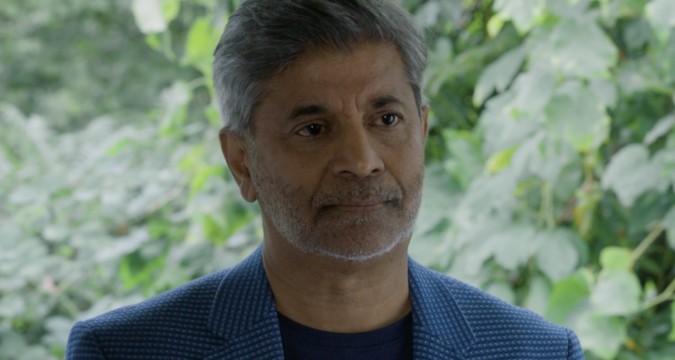
While making my feature The Way You Dance, one of the great pleasures was working with Dhirendra, a Vancouver-based South Asian Canadian actor. A veteran character performer with a career spanning more than four decades since the mid-’80s, he remains remarkably accessible, collaborative, and—above all—an absolute joy on set. In the film, he plays Hanish Patel, the immigrant father of Angel, one of the story’s three central characters. It’s a role he brings to life with quiet depth and authenticity—qualities that reflect his enduring craft. So when I learned he had been nominated for a Canadian Screen Award for his voice performance in Crave’s Superteam Canada, I reached out to him for an interview with CHOPSO. Even after working together, I found myself increasingly fascinated by the arc of his career—and eager to explore the stories behind it.
Dhirendra, what is your creation story and how did you get your start as a performer?
D: I first stepped on stage at five years old. I played an ox. Growing up in a socialist country with state-controlled media, we didn’t have television—at least not then. Our entertainment came from elsewhere: Hindi cinema, kung fu films—part of a cultural exchange with China, who were building the Tanzania–Zambia railway—and Blaxploitation movies.
But the real spark came when I saw ‘Juggernaut’. There was a character named ‘Azaad’, played by the amazing Roshan Seth, (not to be confused with Roshan Sethi, who will talk about late) — an East African Asian exile working as a steward on a ship. Something about that lodged itself in me. The idea that someone like me, a kid from Tanzania, could exist in that world. To paraphrase the infamous line from ‘On the Waterfront’. “I too could be a contender.”
When I emigrated to the UK, the plan was sensible: study Economics, my best subject in high school. That plan lasted until I saw a small ad in a local paper for a theatre workshop.
This was early 1980s Britain—Margaret Thatcher’s Britain. Tense. Fractured. Alive with anger and change. I found myself drawn into a grassroots theatre movement that was gathering momentum in the wake of the racist murder of a 17-year-old in Southall.
Before Canada, you first started your career in UK and you left for Windsor, Ontario. Why did you decide to come to Vancouver?
D: In the UK, I became one of the busiest actors in my peer group.
Working constantly, in film, theatre, television, radio rep … until I wasn’t.
By the mid-90s, I hit a glass ceiling, though I had a range of credits including lead roles (in movies like ‘After Midnight’ opposite Saeed Jaffrey, Hayley Mills, Ian Dury, ‘Binodini’ shot entirely on location in India , ‘Le Prix D’Une Femme’ for FR3 shot entirely on location in Sri Lanka ( where Peri Allan my life partner and I got married on the beach in Colombo, but I digress) classical and contemporary theatre as well as substantial television presence with recurring roles.
The roles were just not being written to sustain a career for someone who looked like me. This was pre Gurinder Chadha’s Bend It Like Beckham which arguably was the one that opened the floodgates.
You feel it before you understand it—So I did something drastic.
I walked away.
Packed it all up and moved to Windsor, Ontario—chasing another passion: wine and food. A different life. A quieter one. But as they say Never Say Never again.
One afternoon, a fax came through from my UK agent, now deceased Roger Carey.
A casting call. The role of Hakeem Jinnah. In a film shooting in Vancouver for the Canadian Broadcasting Corporation.
A crime story based on the “Mr. Jinnah” mysteries by Don Hauka, inspired by real-life crime reporter Salim Jiwa.
The story? A journalist, burned out, walks away from it all… moves to Tanzania to open a burger franchise… and gets pulled back in for one last case.
I remember reading it and thinking— I know this man. Not as a character. As a warning.
Because I’d just become him. And still… because Peri my wife said, ‘hey it’s an opportunity to see The West Coast’. I said yes. Reluctantly. Carefully. Like someone reopening a door they’d deliberately closed. I told myself it was just one job. One last look back. No ambition. No hunger. No need to prove anything.
Just… curiosity.
But standing on set again, under the lights, hearing “action”—the body remembers.
Even when the mind says, don’t.
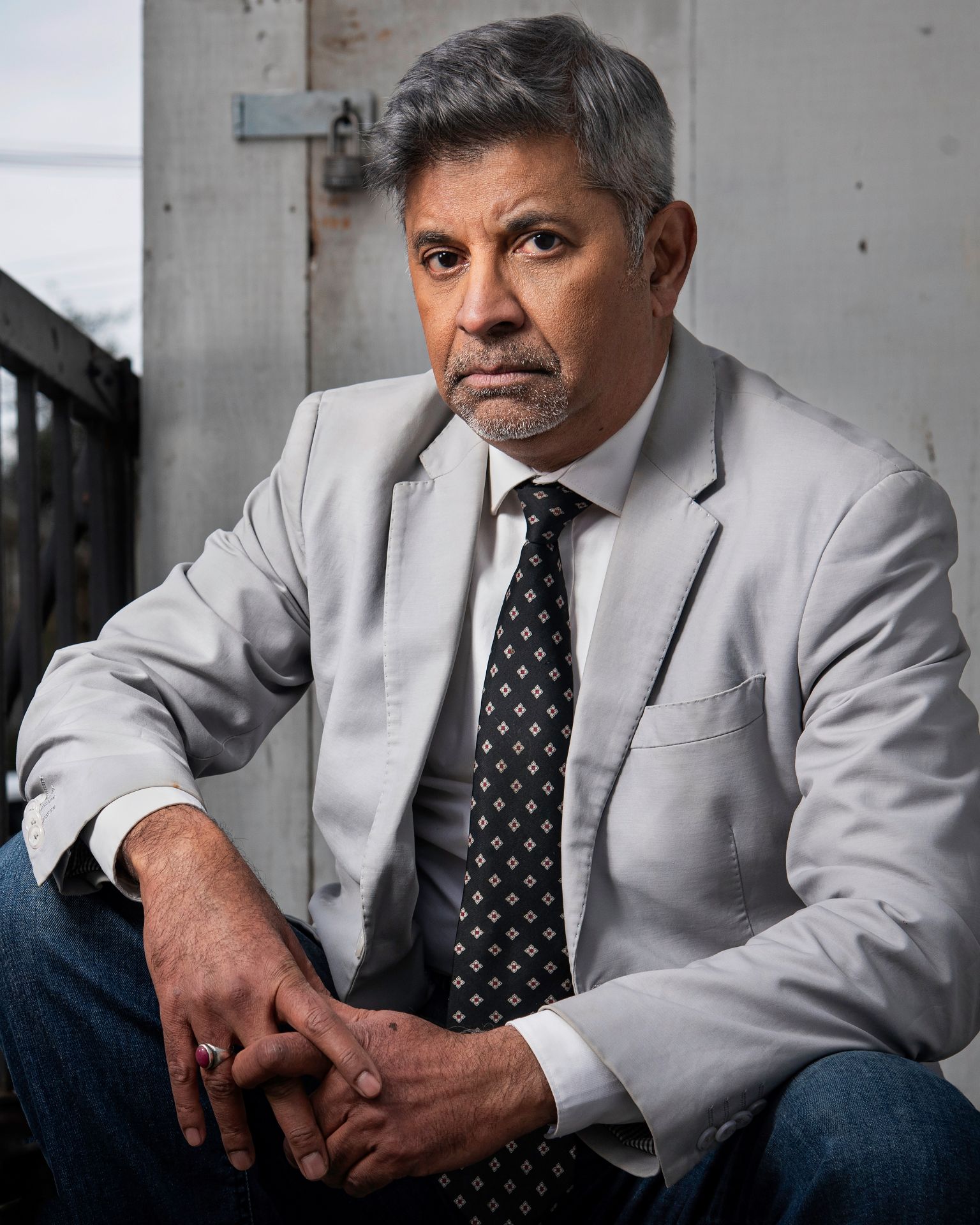
You have started acting as early as 1985, a whopping four decades of career. What is the thing that keeps you passionate every day all these years?
D: After forty years, I’m still here for the uncertainty. For the challenge of the next role—unformed, unpredictable. For the collaboration… the act of bringing our stories to life.
And for the responsibility— to shape how those stories are seen, through the only thing I truly own: my authenticity.
Talk about one of the most memorable project you’ve worked on so far and why.
D: That’s like asking someone which is their favorite finger on their hand.
Each project, each opportunity I’ve been blessed with carries its own uniqueness—each one etched in memory.
Congrats on your Canadian Screen Award nomination! Can you tell us more about the nomination and the project?
D: Superteam Canada streaming on Crave Canada was created by Canadian Emmy®-winning writers, and brothers, Robert Cohen (HBO’s SOMEBODY, SOMEWHERE, THE BIG BANG THEORY) and Joel H. Cohen (THE SIMPSONS), and produced by and starring Will Arnett. It’s an animated comedy based on the exploits of six, little-known Canadian superheroes trying to save the world from evil giant robots, an unemployed octopus, and needy hardware store clerks. The stakes are high for these stereotypically underdog Canadian super-unknowns, who are called in as Earth’s last resort when all the other superheroes have been destroyed. I play one of the arch villains in Episode 9 aptly entitled ‘A Sticky Situation’ called ‘Flapjack’ who holds all the world leaders including the Prime Minister of Canada to ransom for the supply of all of Canada’s Maple syrup.
Voice acting is such a rewarding medium for an actor, one perhaps where one relies on the instrument and as such perhaps empowered with more control than any other recorded media. Unlike film and television where there are so many factors that engage, convey and propel the story like the lighting, sets, etc., also great tools for actor and story telling) with voice its almost raw and unfiltered and the responsibility rests squarely on the actor and their range to engage and propel the story.
You’re also a multi-Leo Awards nominee and in fact you won a Leo for Best Performance by a Male in a Web Series for CBC’s Sort Of. Tell us about that role and project.
D: I was watching Season 1 of ‘Sort Of’, and it ended with the line, “Your father’s coming from Dubai to fix you.” And something in me just… paused. I didn’t just hear it. I felt it. I remember thinking—I want to be that father. Not in a literal sense. But as someone who shows up. Who carries something steady. Who helps put things back together, perhaps.
‘Sort Of’ is a multi award winning show on CBC Gem/HBO Max – including the coveted Peabody Award. It’s a beautiful story of transition that made history winning hearts globally, created by Zaiba Baig and Fab Filippo. Putting into words would not do it justice, you just have to watch to it to experience one of the most groundbreaking, heartfelt gems of this decade.
I play the role of Imran, Sabi’s father who comes home from Dubai, we are led to believe to ‘fix’ Sabi, the first season ends with a cliffhanger as I mentioned earlier,’ Your dad is coming from Dubai to fix you’, setting up all kinds of notions /biases in our hearts and minds of how this father may do so, because of our preconceived notions of how a Pakistani father may deal with a child in transition,
Season two opens with much anticipation of how Imran will live up to the threat of ‘fixing’ Sabi.
Their relationship is central to the show’s exploration of family, identity, and generational gaps, in the 3 seasons but particularly in the second season.
It was an immense privilege playing someone as conflicted as Imran. Grateful to Zaiba Baig and Filippo for having faith in my ability to serve this story.
Before I worked with you, I also saw you in ‘A Nice Indian Boy’ as the amazing wedding planner. Tell us about that role and what the process was like working with filmmaker Roshan Sethi.
D: Another gift of a role, it all started with a zoom meeting with Roshan, we got on the subject about satirising weddings especially recent trends in Indian weddings. The film is a romantic comedy based on a play of the same name written by Madhuri Shekar; however, the wedding planner’s role was not in the play, it was created for the film by screenwriter Eric Randall, then finessed by Karan Soni the lead actor in the film until they entrusted me with breathing further life into the role.
The character was written as an homage to the wedding planner in another wedding classic ‘Monsoon Wedding’, In this instance though, rather ‘abrasive’, high strung, wedding planner, billed as ‘uncle with no filter’ serving as a comedic foil during the intense process of organizing a grand, traditional Indian wedding that too for a gay couple.
I had some specific ideas for him to take it a step further and pay homage to some of the Bollywood villains of the 80’s – Shakti Kapoor, Ranjeet, you get my drift….
Roshan Sethi the Director, whom you presented with an award as I recall, is a gem of a human and a meticulous director with an eye to detail, a true facilitator when it comes to empowering co-collaborators to bring their best to the project. He runs a convivial yet focused set that makes space for people, I was literally in for 2 days at the tail end of the shoot, but Roshan made me feel like I had been there as part of the ‘A Nice Indian Boy Family from Day 1.
Thanks to Roshan’s generosity as a facilitator, allowing time for character ideas to flow, build through improvisations, (one of which can be seen as a deleted scene on YouTube in its 7 glorious minutes) . we were able to create some wonderful magic between Zarna Garg who plays the mother, Karan Soni, Jonathan Groff and I.
He let Flo and I have a lot of free reins in creating the look for the character.
What are you most hopeful for next?
D: Through my work on recorded media and the advocacy work that I do in my spare time for our Union and other nonprofit organisations, to inspire in my own small way, those coming after me in the same way that the legendary Roshan Seth once inspired me to dream and have the audacity.
Follow Dhirendra on Instagram and/or Facebook.