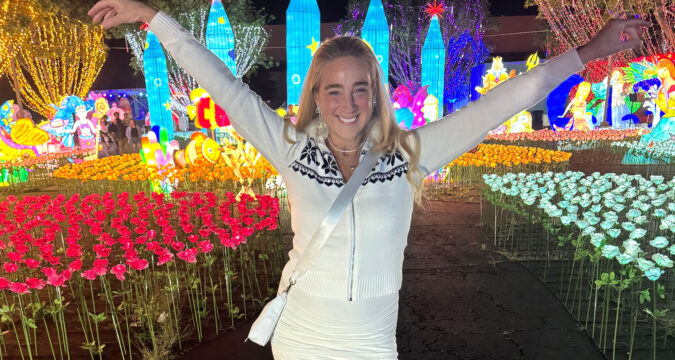
In a hip-hop class at Millennium Dance Complex, I met Diane Paloma Eskenazi, a veteran animator who casually mentioned that she founded her company, Golden Films, in the 1990s and has been producing and directing animated films for more than three decades. Her remarkable career instantly caught my attention, and I knew there was a story worth telling. Inspired and intrigued, I reached out to Eskenazi for an in-depth interview with CHOPSO.
Eskenazi’s Tarzan of the Apes (1998)
I know you started in the 90s… how did you start writing, directing and producing animation?
DPE: I started in the film business writing, directing and producing in my twenties, I was very idealistic and wanted to create positive media. I had spent years studying yoga and had lived in an ashram, I had a little bit of a Mother Teresa complex, and genuinely believed media could help better the world. I was the head of UNICEF in Boulder, and founded Peace Builders a non-profit that ultimately provided of $100 million of medical and other aid to women and children worldwide.
When I moved to New York, I met the people involved in Silver Screen Partners, selling units for prints and ads for the major studios. My father gave me good advice that changed how I approached the industry: “If you want to control the media, you have to control the money.” So I got my Series 7 and Series 63 SEC licenses and taught myself the financing side of the film business. I read every trade paper, surrounded myself with great lawyers, and learned how films were actually financed.
That led me into consulting and financing independent projects for some legendary producers. I worked with Dan Melnick (The Verdict, Straw Dogs, The Goodbye Girl, and All That Jazz) and Ed Feldman (Blue Lagoon, Blame it on Rio, etc.). My move into animation happened unexpectedly. I was approached to finance a slate of animated films from a New Zealand company using fractionated financing—contracts payable on delivery from distributors like Sony. The problem was, the producer didn’t know how to finish or deliver the films. So I stepped in, took over production, and delivered the 6 films to Sony and Polygram, releasing the completion bond and obligation to the bank.
It launched a long-term relationship with Sony, where I went on to write, produce, direct, and deliver 53 animated programs. Other films I produced for Hallmark, Columbia TriStar, etc.
Why did you decide to found your own company Golden Films in 1993 and how has that journey been?
DPE: I founded Golden Films in 1993 because I’ve always been independent by nature. I really didn’t want my values filtered through someone else’s agenda. I had been fortunate early on to have real opportunities and success, but I also saw very clearly how limiting the system could be, especially for women.
At that time, the industry was overwhelmingly male-dominated, and being independent came with real challenges. I experienced sexual harassment and power plays that were simply accepted as “the way things were.” I persevered, but eventually one major studio tried to blackmail me into absorbing their overspending on a project. That was a turning point. I made the conscious decision to step away from the industry and just manage my library of rights which then included over 58 films and over 200 original songs.
Years later, during COVID, I felt a strong pull to return. With a background in editing, writing, producing, and directing I created a number of new films including: the multi-award-winning One World Series, Code Red Planet Earth, Call for Peace, We Rise, 8 new animated compilation films, 2 new animated films, and most recently, the completion of a live-action Christmas special.
The journey of Golden Films has been about resilience, sticking to the narrative of creating positive content, and managing the library which has proven to have very long perennial legs.
Eskenazi’s The Nuttiest Nutcracker (1999)
Among the films you’ve produced, what would you say was your favorite animated film and why?
DPE: With over 60 animated films, I don’t think I have one single favorite so much as favorite moments that live in different projects.
I loved directing Jim Belushi, Cheech Marin, and Phyllis Diller for The Nuttiest Nutcracker. The film was originally intended to be the first 3D animated feature, and creatively, it was incredibly ambitious. Unfortunately, for tax benefits it was handed to a Canadian company that fell far short of my original vision.
What I loved most across many of those films was writing and producing the music. Over the years, I produced more than 200 songs. I loved being in the recording studio—working with musicians, singers, and composers. Some of my favorites were “Keep the Faith” and “Just Believe” sung by Peabo Bryson, “Merlin’s Song” from Camelot, “Pasta and Society” from Gulliver’s Travels, ‘Veggiemania” from Peter Rabbit, “More” from Beauty and the Beast and “Digadoo” from Snow White.
The creative team that were involved in these animated films were amazing, extremely talented performers and artists. We had a ton of fun and I feel really blessed to have been able to do this and also spread joy to literally millions of children around the world.
As we discussed some #metoo moments with high powered people in the 90s… do you think the industry has improved? And talk about why you left the industry for awhile as an independent woman.
DPE: I do think the industry has improved on the surface since the ’90s—but it’s complicated.
At a point, I was exhausted by an industry that normalized abuse of power and then punished women who refused to play along. During that era, I experienced things that today would clearly fall under the #MeToo conversation—being drugged, sexually violated, and subjected to behavior that was quietly accepted as “part of the business.” I never spoke up at the time because that was the culture. If you were an independent woman, you were expected to tolerate it or disappear.
There were very few independent women then, and I do believe that by surviving, staying independent, and continuing to deliver work, I helped carve a path—however imperfect—for other women to follow. Not by being loud, but by proving it could be done.
Has the industry improved? Yes, in terms of awareness, language, and accountability mechanisms. Behavior that was once openly tolerated is now at least publicly condemned. But I’m also concerned about a potential backslide. We’re seeing increasing consolidation, risk-averse corporate leadership, and in some cases a return to very traditional, conservative power structures at major media companies—where control is again concentrated in fewer hands, and diversity of leadership quietly narrows.
When power re-centralizes, independence—especially female independence—becomes threatening again.
That’s one of the reasons I stepped away for many years. And it’s also why, when I returned during COVID, I did so fully independently. I wasn’t interested in re-entering the same system. I wanted to create on my own terms, with my own values, and without asking permission.
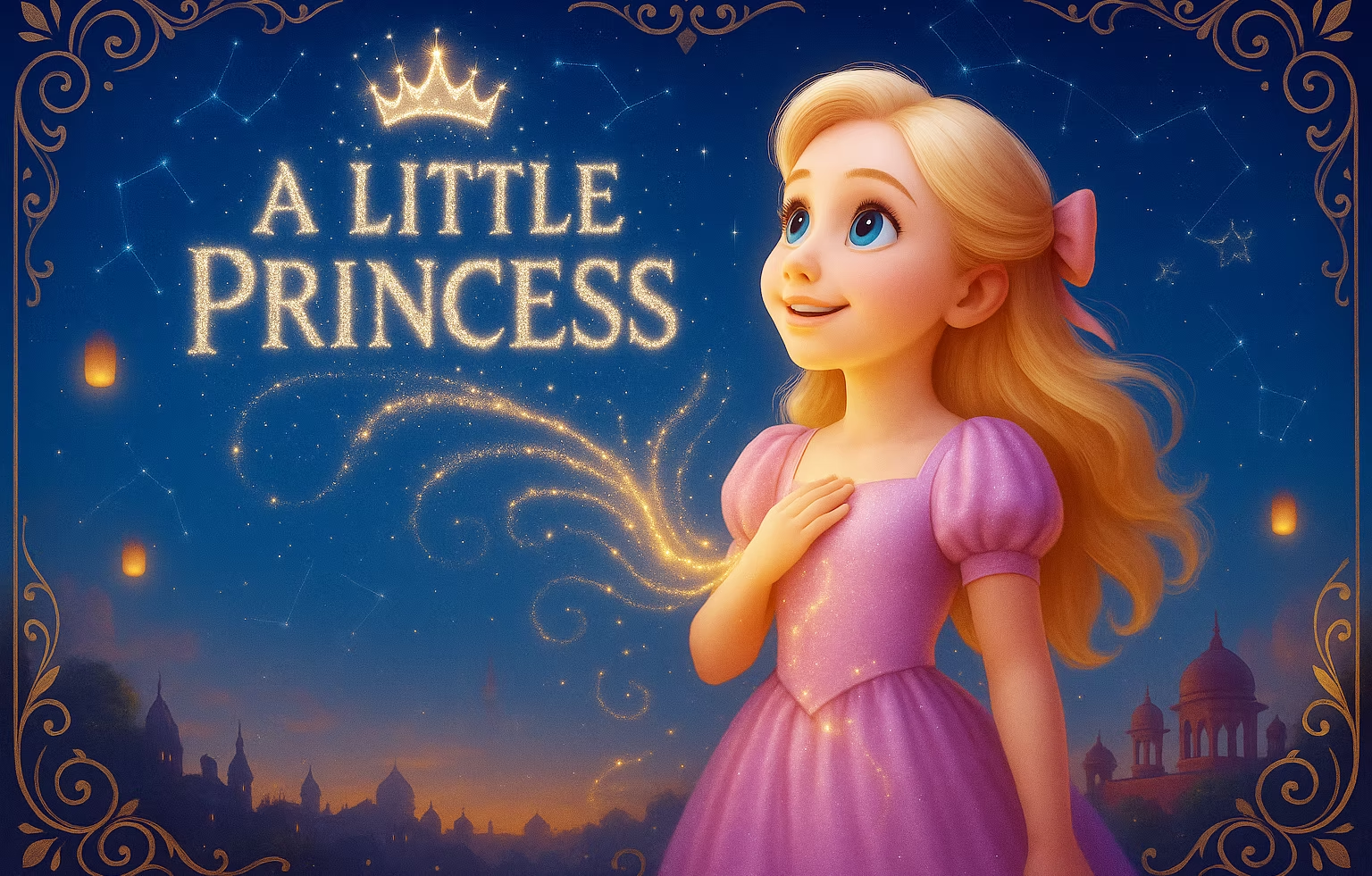
Eskenazi’s latest A Little Princess (2025)
In our discussion, you have used AI as a tool in your recent films. Can you talk about how filmmakers can work with AI for creation?
DPE: I have used a combination of Chat GPT5, Flow, Udio and Eleven labs.
As AI is already a reality in the industry… how is the new AI workflow in creating animation compared to the older non-AI routes? How will AI revolutionize filmmaking in general?
DPE: AI isn’t theoretical, it’s already reality. I’ve fully completed three films using AI, including two animated features with full soundtracks, and they are currently in worldwide distribution on major platforms. I made a very intentional decision to see whether it was possible to create commercially viable feature films 100% with AI—from visuals to music to final delivery.
Are they perfect? No. They were accepted by most major streaming platforms, and they tell positive, meaningful stories. They were completed for a fraction of the cost of traditional animation and in about one-fifth of the time it would normally take to produce an animated feature.
When I compare this to the old, non-AI pipeline—large teams, long timelines, massive overhead, endless gatekeepers—it’s night and day. AI collapses the distance between vision and execution. It allows a filmmaker to iterate faster, experiment more, and actually finish projects that might otherwise never get made.
What excites me most is what this means for the industry as a whole. These tools are evolving daily, and I believe AI will fundamentally democratize filmmaking. It gives producers, creators, and visionaries access to tools that were once reserved for studios with deep pockets. That’s a seismic shift.
My hope—and my responsibility as a creator—is that people remain conscious of the enormous impact media has on audiences. AI can just as easily amplify harmful, formulaic content as it can elevate thoughtful storytelling. I hope creators use these tools to uplift communities, expand consciousness, and move beyond the “safe,” violence-driven formulas that dominate so much traditionally funded Hollywood content.
What is one project you’re most excited about developing and why?
DPE: The project I’m most excited about right now is Entangled. Entangled is a sci-fi romance about the invisible forces that connect us all. When a gifted college student discovers he can manipulate energy, matter and even time itself, he harnesses these powers to save his kidnapped girlfriend, Sierra – and prevent a nuclear apocalypse that would plunge the world into darkness. But his greatest weapon isn’t technology or violent; it’s the deep, spiritual bond that ties him to his girlfriend and to the energetic web that holds the universe together. As his journey takes him from the deserts of Morocco to France and to the heart of Russia, Entangled explores the intersection of science and spirit. High stakes action, mind-bending energy battles and intimate emotional moments. Rooted in the urgent questions of our time – the ethics of AI, the weaponization of technology and the fragile nature of global peace. It’s a story of energy and the Entangled nature of all things.
Check out Diane Paloma Eskenazi’s company Golden Films’ website and follow her on Instagram!