
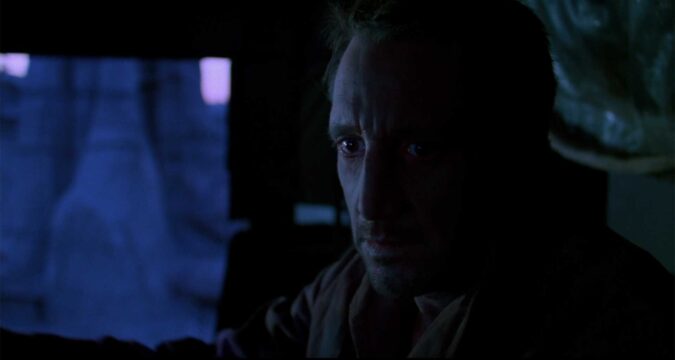
Released in 1977, William Friedkin’s Sorcerer remains a classic thriller that still holds up nearly five decades later. It is a masterclass in filmmaking, proving that true craft is timeless. Cinema is literature in motion—just as a great novel can endure across generations, so can a great film. Well-crafted images, like well-chosen words, do not fade; they stand as lasting testaments to our history and humanity. Released just one month after Star Wars in 1977, Sorcerer faltered at the box office, grossing $9 million worldwide against a $21 million budget. Yet as filmmakers, we cannot control a film’s commercial fate. What we can control is the quality of the work itself—creating something so well made that future generations may rediscover it and recognize its worth.
Zooming gets a bad rap for its overuse in ’70s exploitation films, where it often became a stylistic crutch that instantly timestamped a movie. But note how Friedkin employs the zoom sparingly and with precision—it makes me realize, even today, that it was exactly the right way to shoot those moments. In his hands, the zoom isn’t a gimmick; it’s a necessary tool.
Most stunning to me is the day-for-night sequence near the end of the film. Pragmatically, it would have been incredibly difficult to light such an expansive exterior location for a true night shoot. By opting for day-for-night, Friedkin is able to capture the rich detail of the wideshots—the texture of the landscape, the oppressive vastness of the environment. At the same time, the slightly surreal, otherworldly quality of the day-for-night aesthetic mirrors the protagonist’s psychological unraveling. Form and emotion become inseparable.
That’s the moment I realized Friedkin wasn’t just a skilled craftsman—he was a master filmmaker.
Sorcerer also exposes the limitations of mass-market film criticism. In Leonard Maltin’s annual Movie Guide, the film receives only two-and-a-half out of four stars, dismissed with the line: “Expensive remake of The Wages of Fear never really catches hold despite a few astounding scenes.” Such capsule reviews reduce a complex work to a market-friendly verdict, flattening nuance into a consumer advisory.
When criticism becomes shorthand—an efficiency model built around star ratings and one-line summaries—it risks degrading the deeper inquiry that serious, academic criticism attempts. Rather than simply guiding a general audience toward or away from a ticket purchase, film criticism at its best should illuminate how a film reflects, refracts, or challenges the cultural values of its time. It should contextualize, interpret, and provoke thought.
Sadly, many critics in the 1970s failed to see that dimension in Sorcerer. Time, however, has proven more discerning. The film now stands as a work of far greater cultural and historical value than its initial reception suggested—a reminder that critical consensus, especially in the moment, is not always synonymous with lasting insight.